He dodged kamikazes in the East China Sea
VETERANS DAY SALUTE
Mutual 15’s Duane Vienna reflects on life aboard the USS Evans and the Battle of Okinawa
by Ruth Osborn
Communications Director
May 11, 1945: It’s been 81 years since that day on the placid East China Sea. Visibility was unlimited at sea level. Low-hanging clouds scudded across the morning sky, shrouding the coming threat.
The sea was calm, but life aboard the destroyer USS Evans was tense, remembers Duane Vienna, a 99-year-old resident of Mutual 15. Vienna joined the U.S. Navy at age 17. This was his first assignment.
He was aboard the ship stationed at Radar Picket Station No. 15, one of 16 stations ringing the main Okinawa invasion fleet. Their purpose? To use radar to track incoming bombers and kamikazes, and serve as first defense against any onslaught. It was a sacrificial assignment. By the end of the day, hundreds of airmen and sailors were lost or dead in one of the most furious air-sea battles of the war, according to the Presidential Unit Citation presented to the crew of the USS Evans in late 1945.
Nazi Germany had surrendered three days earlier, on May 8, but the war in the Pacific would not end for four months. Allied forces were still locked in the brutal Battle of Okinawa.
May 11 began calm and still. The USS Evans was in a lonely spot 40 miles away from the main fleet, deliberately isolated as its early warning shield. Alongside was sister destroyer, the USS Hugh W. Hadley.
“It was like being in a football game, wild, crazy, battle chaos from all directions, from all sides, high and low.”
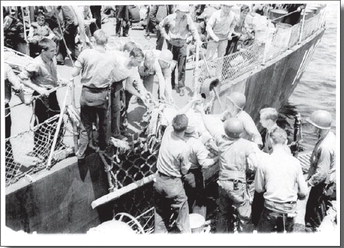
Above: Casualties from USS Evans are brought aboard a fl oating hospital after the Evans was damaged by Kamikaze attacks in 1945.
Offi cial U.S. Navy Photograph | National Archives
Duane Vienna, age 17 At 7:55 a.m., radar operators tracked an incoming wave of roughly 150 Japanese aircraft heading directly toward their picket station as part of the Kikusui air attacks, according to Naval History and Heritage Command (NHHC).
Vienna remembers the 95-minute battle as a collage of chaos—swarms of diving kamikaze suicide planes, air filled with black puffs from exploding shells, red tracer rounds from anti-aircraft guns, planes exploding in mid-air, geysers of water as bombers slammed into the ocean.
Vienna was on the second stack. His battle station was located near the rear smokestack, next to the deadly 40mm anti-aircraft gun mounts. As a spotter, he had a bird’s eye view of the enemy aircraft “firing from all directions.” Both ships valiantly answered the assault.
Vienna wore heavy, dark Navy flight goggles as he stared into the sunny horizon on an elevated platform. His job was to scan his sector of sky, identify the type of incoming Japanese plane and yell coordinates to the gunners.
In answer, the ship’s guns fired rapidly, creating giant, black clouds of exploding flak and tracer shells. The air was thick with sulfur, and the gun blasts rattled teeth. He saw planes blasted apart mid-air, sending flaming wings and tails spinning into the sea yards away. The most terrifying moment was watching the planes that didn’t miss. Vienna saw the kamikaze planes slam into his ship, leaving it dead in the water.
During the battle, sister ship Hadley shot down an all-time Navy record of 23 planes in a single engagement, and the Evans shot down 14 and helped to down three others.
Then a coordinated attack by five Japanese planes ultimately crippled the Evans, flooding all engineering spaces and igniting fire that raged amidships, according to the NHHC.
The crew “fought desperately against almost insurmountable odds and, by their indomitable determination, fortitude and skill, brought the damage under control, enabling their ship to be towed to port and saved,” states Presidential Unit Citation, which hangs on Vienna’s wall along with other military honors and commendations.
“It was like being in a football game, wild, crazy, battle chaos from all directions, from all sides, high and low,” he said.
The presidential citation explains it best: “Fighting valiantly against waves of hostile suicide planes plunging toward her from all directions, the USS Evans sent up relentless barrages of anti-aircraft fire during one of the most furious air-sea battles of the war.”
Thirty-two crewmen died on the Evans that day: “The guys that were killed were mostly those below deck in the engineering spaces. I never got a scratch,” Vienna said.
After the “abandon ship” order came, Vienna and crewmates ran to the bow of the ship and jumped off.
“The ship was sinking. I was swimming away. A kamikaze came right at us, and I thought we’re goners. At the last minute, the plane went over sharp to the other side and crashed.” Vienna and other crewmen were plucked from the sea by rafts. He lived to serve another day.
Vienna was still a kid of 19 when he was honorably discharged from the U.S. Navy after the war ended in 1945. He went on to earn a college degree
Duane Vienna poses in front of the World War II memory wall displayed in his Mutual 15 home.
Ruth Osborn in San Diego and then enlisted in the U.S. Air Force, where he served as an administrator. Staff Sgt. Vienna was honorably discharged in 1952, and his civilian life began in earnest: “All things considered, I’ve had an interesting, adventurous life; 81 years later, here I am, and I can’t complain.”
A purchasing manager by profession, his first marriage lasted 54 years. He and his wife, Nancy, had a son John, who is a retired electrician and lives in Rancho Cucamonga, and a daughter, Pattricia Vienna, who is a retired attorney living in Mutual 7.
Duane and Nancy moved into Leisure World in 1996. He was widowed in May 2003 and, in a fortuitous coincidence, was friends with next-door neighbor Marge, whose husband had also just died. They fell in love, were married and had 11 happy years cruising the oceans on Princess Cruise Lines and generally enjoying LW living.
Marge died in 2014, and he met Lynn Lieder, who was also a neighbor and friend. The couple married in 2015. Lynn and Duane enjoy laughing and joking with friends and extended family members. They are living their best lives and sharing the golden years together in LW.
The Battle of Okinawa became the costliest campaign in U.S. Navy history, resulting in 36 sunk ships, 368 damaged ships, and nearly 5,000 sailors killed, according to Wikipedia.
It was the last major battle of World War II, fought from April 1-June 22, 1945.
The USS Evans and sailors like Vienna played instrumental roles, deservedly earning presidential honor for “extraordinary heroism in action as Support Destroyer on Radar Picket Station Number 15 during an attack by approximately 100 enemy Japanese planes, forty miles northwest of the Okinawa Transport Area, May 11, 1945.”
The sacrifice of picket ships like the Evans and the Hadley accelerated the development of early-warning radar systems, combat air patrols, and rapidfi re anti-aircraft strategies that formed the foundation of Cold War naval defense, according to the NHHC.
Vienna’s military service began in the catastrophic struggle to end a world war. After the Battle of Okinawa, the U.S. chose to deploy atomic bombs on Hiroshima and Nagasaki in August 1945, leading directly to Japan’s unconditional surrender just weeks later.
Vienna was one of 16.4 million Americans who served in World War II between 1941 and 1945. And he is one of about 30,607 veteran survivors in the U.S., according to the U.S. Department of Veterans Affairs and The National WWII Museum.
California is home to an estimated 5,094-10,703 World War II veterans, the largest population of WWII veterans of any U.S. state.
Leisure World is privileged to call Vienna its own and salutes his valiant service to his country on this upcoming Veterans Day.
Editor’s Note: As the saying goes, freedom is never free; it is ensured by the sacrifice of ordinary people like Duane Vienna who chose to do an extraordinary thing: serve his country. Veteran’s Day on Nov. 11 gives everyone the opportunity to thank U.S. veterans for their courage, discipline, and dedication to the United States of America.