Everything you missed at the executive director’s community forum: FAQs and more
COMMUNITY FORUM HIGHLIGHTS
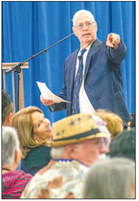
On Jan. 30, GRF Executive Director David Norvell took to the podium in Clubhouse 4 to introduce himself to the Leisure World community.
After a brief introduction, he went to work answering a long list of resident-submitted questions that ran the gamut: insurance, payroll and personnel, contracts, traffic safety, contractor management and more.
Here is an overview of his answers:
• What steps are being taken to reduce management payroll costs? Management regularly reviews staffing levels, organizational structure, vacancies and workload distribution to ensure alignment with operational needs and budget constraints. Payroll decisions are evaluated in the context of service delivery, regulatory requirements and risk management.
• Why are contracts provided in heavily redacted form, and how can transparency be improved? Contracts are provided in accordance with applicable legal and contractual requirements. Redactions are limited to confidential, proprietary or legally protected information. Management continues to balance transparency with legal obligations. Anyone can request a review if they are denied information.
• Why have GRF Board and committee minutes become less detailed than in the past?
Meeting minutes are intended to document actions taken, not discussion or debate. However, all shareholders have the ability to review any meeting video to see the entire context and tone, which minutes cannot provide. Current practices align with recognized governance standards and focus on clarity, accuracy and legal sufficiency.
• Are Non Disclosure Agreements (NDAs) still used, and who determines when they are necessary? NDAs may be used on a limited, case-specific basis when appropriate. Their use involves management, legal counsel and governance considerations consistent with applicable law and GRF Board policy.
• Who is authorized to contact GRF’s attorneys, and how is legal spending controlled? The people authorized to contact GRF attorneys are the HR Director, Executive Director, Executive Manager and GRF Board President. Engagement with legal counsel follows established governance and management protocols. Attorneys serve in an advisory capacity. Legal expenditures are monitored through budget oversight and GRF Board review processes.
• What analyses are being used to evaluate solar proposals?
Solar proposals are evaluated using financial modeling, operational considerations, risk assessment and regulatory review. Any proposal advances through established governance processes and GRF Board review prior to approval.
• Why does the intersection at St. Andrews Drive and Golden Rain Road lack a protected left-turn signal, and what evaluations have occurred? It was advised by the contracted traffic engineer. The next step is to ask the GRF Board if they would like a second opinion. Traffic signal design and enforcement involve coordination with appropriate authorities. Existing signage meets or exceeds applicable standards. Management continues to monitor safety concerns and coordinate with relevant agencies as appropriate. There is a repeated question in the community asking why GRF did not install left-turn signals on St. Andrews Drive like it did along Golden Rain Road at the intersection. The answer, besides the engineering firm saying GRF did not have to, was that the poles in place now would not carry the added load of such an added signal and to replace the poles and their stronger footings was estimated to cost $1 million.
• How can misunderstandings regarding new traffic patterns and signals be addressed? Signage and signals meet applicable standards. Information is provided through existing communication channels. Drivers and pedestrians are responsible for complying with posted signals and traffic laws.
• Can additional enforcement, cameras or penalties be implemented? Additional staffing or enforcement measures would involve operational, legal, and cost considerations. GRF does not have authority to restrict driving privileges, based on current information. Signage meets public standards. Ultimately, compliance is the responsibility of drivers and pedestrians.
• Is anything preventing Mutuals from unifying behind a single technology provider? Participation in bulk or community- wide technology services is voluntary and governed independently by each Mutual. GRF may facilitate communication and education but does not mandate vendor selection.
• What is being done to address perceptions of an “us vs. them” dynamic between residents and staff? Management is focused on reinforcing professionalism, service standards, and consistent communication. A new GRF courtesy card will soon be distributed by staff to residents as interactions are transacted to ensure the resident has a point of contact until his or her issue is resolved.
• What is being done to improve trust and reduce fear of retaliation or delayed service? Building trust and ensuring residents feel comfortable raising concerns is a priority for management. GRF staff ’s purpose is to serve the membership, and management expect all interactions between staff and residents to be professional, respectful and constructive. While it is not always possible to meet every request, management is committed to explaining decisions clearly and respectfully. At no time should a resident feel disrespected, just as staff should be treated with courtesy in return. GRF’s focus remains on fostering a collaborative environment built on professionalism, responsiveness and mutual respect among staff, the GRF Board and residents. If a resident believes they have been treated poorly or feels their concern was not handled appropriately, they are encouraged to request a meeting so the situation can be reviewed.
• Is GRF considering self
After GRF Executive Director David Norvell fi nished answering pre-submitted questions, he took questions from the audience.
Paul Kryczkoinsurance? Insurance for large community associations is a complex and highly regulated area of the insurance industry. The decision to self-insure versus purchasing traditional insurance coverage involves significant financial, legal, administrative, and risk-management considerations. Traditional HOA insurance transfers risk to a third-party insurer, providing predictable coverage limits, claims handling, regulatory compliance, and protection against catastrophic loss. Self-insurance, by contrast, requires the organization to assume and manage that risk directly. This typically involves establishing substantial reserve capital, creating a formal risk pool, retaining third-party claims administrators, securing excess or reinsurance coverage— buying insurance once again, and maintaining ongoing regulatory and actuarial oversight. All cost money.
• If the Master Policy deductible exceeds HO-6 loss assessment coverage, is the resident responsible for the gap? Possibly yes—if the Master Policy deductible is higher than what your HO-6 policy covers for loss assessments, you may be responsible for the difference, so it’s important to review your coverage with your insurance agent. It is important to have your agent view your specific Occupancy Agreement to ensure that you have appropriate coverage. Occupancy Agreement responsibilities can change over time.
• Does the Master Policy only cover original structures, excluding remodels or alterations?
The Master Policy will cover original structures, and will not exclude remodels or alterations if proper permits were filed. If no proper permits were pulled, it will be rebuilt to its original specifications.
• Is GRF tracking replacement of recalled electrical panels, and is there a completion date? Yes, this information is tracked and updated as contracts and escrows are completed. There is no estimated completion date. The Mutuals have been and continue to replace panels as monies permit and most utuals are aggressive.
• Given rising premiums and claim history, are insurance alternatives being explored?
Annually, GRF’s broker reaches out to industry experts and advises. Insurance costs and coverage strategies are periodically reviewed with professional advisors. Decisions are informed by risk exposure, market conditions and financial prudence.
• What steps are being taken to improve coordination between departments? Improving coordination between departments is an ongoing focus. The Executive Director has held multiple meetings with senior staff to reinforce that GRF operates as a collaborative organization, with a clear expectation that departments work together and communicate effectively at all levels of management and staff. Lack of coordination that negatively impacts the community is not acceptable. If the service residents receive is sub-par, and they get no satisfaction, the Executive Director needs to know about it.
• Residents have raised concerns about households with multiple vehicles consistently parking on main streets while assigned carport spaces remain unused. Can limits or additional fees can be imposed?
Historically, GRF assigned two Security officers whose sole responsibility was traffic and parking enforcement. Those dedicated positions were eliminated several years ago. Today, parking enforcement is handled by patrol officers in addition to their primary responsibilities, including gate operations, calls for service, and safety response. While patrol does conduct parking enforcement, it must occur after higherpriority duties are addressed, and on some days this leaves limited time for proactive enforcement. While we continue to enforce existing rules as resources allow, imposing additional regulations without dedicated enforcement capacity is unlikely to resolve the underlying concern. A common challenge is that a vehicle may lawfully park on a street and remain there for up to 72 hours before being moved. During that time, other residents may wish to use the same space, which understandably creates frustration. It is also important to note that this is not a lack of parking issue, but rather a proximity issue. Parking spaces are available throughout the community. On multiple occasions, including during overnight hours, counts have confirmed hundreds of open spaces on trust streets, including dozens on individual streets such as St. Andrews. The concern arises when residents understandably prefer to park as close as possible to their unit, and for visiting family members to do the same, even when assigned carports or available street parking farther away exist. The question is: Does Leisure World has more parking availability than many comparable communities? OR is the challenge convenience and walking distance which can play a significant role in perceptions of scarcity. We remain open to continued discussion and welcome collaborative, practical solutions that balance fairness, safety, and available resources to impose limits and the additional fees they desire.
• How were the $9,000 traffic bumps evaluated for cost, necessity and street placement?
In the first phase, GRF Security provided several areas of concern they knew of from their patrols. The Facilities Committee reviewed those areas and made a recommendation to the GRF Board for installation. The most recent method was to place speed (radar) signs in areas of concern and use the data to see if there was, in fact, speeding in the suggested area. The Facilities Committee will review two areas to recommend to the GRF Board at an upcoming meeting.
• How is contractor performance monitored on large-scale projects? A building inspector is assigned to the project along with the GRF Physical Property Manager. Depending on size of the project, a third-party project manager may be called in.
• What accountability measures are in place when contractor work must be redone? Full payment is not provided until performance is met. A 10% retention is held until 30 days after project completion.
• What controls and reporting mechanisms are in place to prevent budget overruns? The GRF was under budget as of November 2025—current financial controls worked.
• Does the community periodically evaluate its legal services for pricing and consider alternative options? The GRF periodically reviews its legal services. The HR/labor law firm has changed recently, while general counsel has remained the same to ensure continuity in HOAspecifi c legal guidance.
• Does Leisure World receive financial advice from its financial institutions at no cost? Leisure World receives certain levels of advisory support from its financial institutions at no cost. If additional services or specialized expertise are required and subject to fees, those services would be evaluated and negotiated in advance.
• How does management assess whether leadership roles are staffed with appropriately qualified individuals given today’s operational and financial complexity? Management evaluates staff qualifications and leadership effectiveness based on operational needs, project oversight requirements, and the increasing financial and regulatory complexity of the organization.
• Has the GRF Board evaluated whether an Executive Manager and a Chief Financial Officer structure would be most effective? To date, such a structural evaluation has not formally occurred. Management intends to present a proposed organizational structure for GRF Board consideration.
• Because LW Weekly is funded by the Golden Rain Foundation and serves as a primary forum for shareholder communication, could you clarify how editorial independence is maintained—particularly with respect to Letters to the Editor? Specifically, how do we ensure that shareholders with respectful but critical perspectives have fair access to this forum? A team of professional editors and designers produce the LW Weekly with the primary purpose of educating and informing residents of GRF-related news, events and governance. Of high priority is giving residents a platform to publicize clubs, events and services to foster community unity. The Leisure Weekly is not a mainstream paper as it is not a voice for all. For example, only Leisure World residents have access to editorial content, and political letters will not be published, per GRF policy.
GRF Policy 42-2806-1, Community Publications, spells out editorial guidelines for the paper. Every contributor who sends a submission receives a response from an editor. If something cannot be published for any reason, editors will explain why and what can be done to make submissions eligible to print. Regarding letters to the editor, complaints and criticism are acceptable as long as they are not inflammatory, libelous, or otherwise inappropriate.