Council approves water, sewer rate hikes in 3-2 vote
SEAL BEACH CITY COUNCIL
by Emma DiMaggio
Communications Manager
At its Aug. 11 public hearing, the Seal Beach City Council narrowly approved increases to the city’s water and sewer rates in a 3-2 vote. Those increases are expected to hit Seal Beach residents’ bills beginning Aug. 1.
The new rates won’t impact assessments until Jan. 1, 2026. That’s because Mutuals’ 2025 budgets are fixed for a full year. Though residents may notice higher charges on their Mutual Financial Statements starting as early as August, Mutuals cannot pass those costs on to residents until they budget for them.
When budget season begins, Mutuals will account for the rate increases, forecast expected costs, and integrate those prices into their 2026 assessments.
The approved rate increases will affect fixed rates related to water delivery, volumetric rates which charge for the amount of water used, and both fixed and volumetric rates for sewer services.
The new rates are expected to double LW residents’ water bills over the next five years, with the biggest jump in the first year of implementation. In the following four years, rates will increase steadily but at a slower rate.
“The system, right now, is on the edge of collapse in many places,” said District 5 Councilmember Nathan Steele, who represents a portion of Leisure World. “If we don’t pass this [rate increase], the pain will be incalculable.”
All three “yes” votes—Steele, Old Town and Surfside Councilmember Joe Kalmick, and Councilmember Ben Wong representing Leisure World, College Park West and Rossmoor Center— unenthusiastically approved the increases.
Each expressed regret at having to increase their residents’ utility bills—as well as fear that delaying increases could spell disaster for the city’s utility systems and overall fiscal health.
Seal Beach residents will face increasing bills over the next five years Under the proposed rates, Leisure World’s water and sewer bills will nearly double over the next five years.
Over the next five years, the cost of a hundred cubic feet of water will increase by 97%. The flat rate for sewer services will increase by 117% over that same period.
The community will also pay increased fixed charges for water delivery. Previously, Leisure World was only charged for one 6-inch pipe, despite being served by two 12-inch pipes.
A city-hired consultant concluded that, though LW doesn’t often use its second 12-inch pipe, it still needs its capacity to meet peak flows—such as when first responders use fire hydrants—and therefore LW must pay for it. Previous studies did not account for these peak flows.
That decision will increase LW’s bi-monthly costs from $1,331.01 to $14,916 in the first year. By 2029, the bi-monthly charge will be $21,239.12.
Exact bill amounts will fluctuate based on the community’s water and sewer use. In Leisure World, the cost of water is divided evenly between the community’s 6,608 households.
Opposition fails to delay water rate hikes Two councilmembers voted against the rate hike proposal: District 3 representative Mayor Lisa Landau representing the Hill, Coves, Bridgeport and Heron Pointe, and District 4 Councilmember Patty Senecal, representing College Park East and Town Center. The two attempted to pass an “Option 3” scenario, which failed 3-2.
Previous proposals by staff included an Option 1—a highrate proposal that aggressively repaired infrastructure—and an Option 2 that featured slightly lower rates with less capital improvement projects.
Senecal’s “Option 3” would have reduced the number of capital projects from 11 to five; reduced funding for capital and reserve funds; and created a website to track water and sewer projects. It also would’ve directed staff to embark on a litany of studies: a water and sewer master plan, an updated water and sewer capital improvement project, an updated cost allocation plan and an additional rate study.
Public Works Director Iris Lee estimated that those studies would cost about $500,000 and take approximately three years to complete. The city would be required to pay for the studies using the General Fund—which pays for city services like fire, police, and community services in the city.
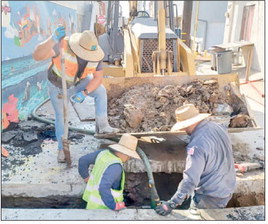
Senecal’s proposed plan would also defer maintenance on the remaining six, highpriority infrastructure projects— one of which, the Water Infrastructure and Compliance Program project, included work on a water main that has failed three times in the past year and has required repairs to the tune of $1 million.
“We’re talking about cutting back the Capital Improvement Projects. On paper that looks like a wise decision, but in reality, those are all ticking time bombs,” Councilmember Kalmick said. “The projects that are going to be deferred—what happens if one of them fails before we’ve allocated funding for the repairs?”
Kalmick continued: “What bothers me is the assumption that our professional staff and consultants who have been in the business for many years are treated as if they just got here yesterday.”
Landau suggested using the General Fund to loan money to the Enterprise Fund, which supports the water and sewer systems, to help it qualify for other loans.
Such a move would negatively impact the city’s bond rating and increase interest on future loans, according to city Finance Manager Alayna Hoang.
The back-and-forth was cut short by a motion to vote on the staff-recommended “Option 1,” which passed 3-2.
“What bothers me is the assumption that our professional staff and consultants who have been in the business for many years are treated as if they just got here yesterday.”
—Councilmember Joe Kalmick