provided bids. Crosstown Electrical ….
provided bids. Crosstown Electrical and Data, Inc., a Southern California-based electrical contractor that specializes in traffic signals and construction, was selected.
Change Order: On April 22, the board approved a $37,651 change order from reserve funding. The change was needed to accommodate a larger underground pipe size, which was not part of the original scope of work. A destructive inspection by GRF staff—which entails digging up the street to uncover defects—would have revealed the discrepancy but at a higher cost than that of the change order for an overall savings. The project could not have continued without approval of the change order.
Project Review: The GRF Board approved the project in July 2024 in keeping with the findings of a traffic study to improve safety features at the intersection. The plan is based on recommendations by GRF’s traffic engineer. The board and the Physical Property Department are overseeing execution of the project. No permit is required from the City of Seal Beach.
• What are the plans to ensure reserve/capital funds are over 75% funded?
A reserve study is a longterm financial planning tool used to evaluate the condition and expected lifespan of major common-area (Trust) components like roads and roofs. It helps determine how much money should be set aside each year to pay for future repairs or replacements. The community’s reserve fund is currently 78% funded, which is considered very healthy. Anything over 70% means there’s a low risk of needing a special assessment. Reserve funds are not spent all at once. They’re used as projects come up, and replenished annually through dues. This planning helps keep GRF finances stable and protects property values.
Capital funds have no legal requirement for percentage of funding; however, capital expenditures are monitored closely by the GRF Board and staff.
• How many closed executive sessions were held in 2024, and who is invited and why?
Executive sessions are closed-door talks that only board members and certain other invited people—executive GRF staff, vendors and subject matter experts such as insurance brokers—can attend. The GRF Board held 24 total in the 2023-2024 term. Nine meetings were held in 2023, 15 meetings through June 2024, when the term ends. From June 2024 to present, 24 meetings have been held. By law, topics such as contracts, disciplinary hearings and personnel issues among others must be confidential. Members do not have a right to attend executive session meetings.
• How often are contractors within Leisure World Seal Beach reevaluated and what is the standard procedure for selection process?
Contractors working in LWSB must be licensed, bonded and insured. They are annually reviewed and at the time of entering a contract with a shareholder or the GRF. Contractors new to the community must provide a payment and performance bond for each job until they’ve completed $100,000 worth of work over three years (except in Mutual 7). Contractors without proper documentation must update it before working in LWSB. GRF uses a list of pre-screened contractors from Community Associations Institute (CAI) professional services and prescreened contractors who have previously worked in LWSB. If a contractor wants to work here, he or she must apply through Physical Property and provide the required documents.
• What made the board decide to give the executive director complete control of hiring, firing and increasing managerial positions. And have there been any discussions about the board revoking that decision?
For more than 30 years, the GRF Executive Director has managed staff in a relationship similar to the city council/city manager interface. The GRF Board oversees the executive director, and the executive director is responsible for GRF personnel. The Administration Committee recently changed its charter to add the following personnel responsibilities: Review and approve new job descriptions, and review and approve amended job descriptions that include a paygrade change.
• Explain the rationale behind changing the fine schedule to give GRF Directors “sole” discretion?
The GRF board of directors has always had sole discretion in its role as a governing body of Leisure World. Only recently was the word “sole” added to the policy.
• Who pays for replacement of broken gate arms at the entry gates and how many traffic gate arms are damaged each month?
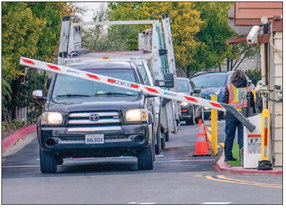
Barrier gate arms are designed to break away when hit and can usually be reinstalled by GRF Service Maintenance. This design is cost-effective compared to traditional barrier arms.
Gate Arm Repair Payments:
If repairs are needed, costs vary based on labor and parts. When possible, GRF bills the driver responsible for the damage. Most incidents are caused by drivers entering the community. Each case is documented by Security, and reviewed by management and the board. A recent accident at the front gate damaged not just the arm, but part of the assembly. Since the damage was more severe, parts had to be ordered, which delayed the repair.
Gate Arms Damaged: According to Security Director Victor Rocha, gate arms are broken at an average rate of one per week, which is minimal considering that more than 100,000 vehicles a month enter through LWSB’s three gates.
• What are the GRF finance managers’ qualifications? CPA?
The Finance Department includes three team members with accounting degrees, including the finance manager. Most of the team has been with GRF for over five years—many for more than 10. Accounting for communities like LWSB, especially stock cooperatives, is specialized, and the GRF is fortunate to have such experienced staff at LWSB. The Executive Manager of Mutual Services has a college degree, though not in finance, plus several common interest development(CID) certifications. He oversees multiple departments for GRF, not just finance. He has 20 years in the HOA management field, including oversight of finance and accounting services.
The GRF Board oversees the executive director, and the executive director is responsible for GRF personnel, similar to the relationship of a city council and city manager.
• How many employees quit or were fired from 2022 to 2024? Of those, how many received severance pay, signed non disclosure agreements or involved lawsuits? What was the total amount of severance paid and what was the average employee severance package of the above dismissals? Are there currently any employee litigation suits open?
Employee Terminations:
From Jan. 1, 2022, to Dec. 31, 2022, there were 52; from Jan. 1, 2023 to Dec. 31, 2023, there were 43; from Jan. 1, 2024, to Dec. 31, 2024, there were 37; from Jan. 1, 2025, to the present, there were 16. These numbers include both involuntary and voluntary separations and have been declining year to year.
Severance Pay and Non Disclosure Agreements: California Civil Code (also known as the Davis-Stirling Act) does not require associations to disclose personnel-related information (e.g. terminations and separations), and California privacy laws protect such information. While the Act does require disclosure of certain construction- related litigation, it does not require disclosure of severance agreements and employee lawsuits. Non-disclosure agreements mean all parties keep terms confidential.
Severance Packages: Personnel issues related to severance and non disclosure agreements are confidential. That information is not available to shareholders in accordance with Civil Code and GRF policy to protect the employees’ privacy rights.
• What is planned to thwart speeders and stop sign runners on St. Andrews between Golden Rain Road and St. Andrews Gate?
The Seal Beach Police Department issues tickets for moving violations within Leisure World. GRF has installed speed cushions throughout the community and is planning on installing them in other locations. There are also flashing speed signs to alert drivers of their speed.
• What performance reviews have been put in place to measure the efficacy of departments and individual employees?
GRF managers conduct annual performance reviews for all employees, who are rated on a 1-to-5 scale in the areas of job performance, teamwork, leadership, collaboration and potential for growth or training. The comprehensive evaluations start in June. Annual evaluations for merit raises, which are based on performance, begin in September.
• Why has the board failed to respond meaningfully to well-supported and reasonable petition requests? Why has leadership chosen to downplay or dismiss the clearly expressed will of thousands of shareholders?
At the April 22 board meeting, GRF directors responded to a recent petition circulating in LWSB, summarized as follows: Thank you for your petition and for caring about the future of Leisure World Seal Beach. The GRF Board has reviewed it and appreciates your concerns. While leadership and budget decisions fall under the board’s legal authority, we hear your desire for more transparency, accountability, and communication.
We take your feedback seriously and know that rebuilding trust means more than just following rules—it means improving how we listen and engage. That’s why we’re holding events like this town hall and exploring better ways to involve residents in the decision-making process.
The 2025 budget was developed over several months with input from staff and public meetings. While we consider outside factors like inflation and Social Security increases, we also have to respond to real cost increases in insurance, labor, and infrastructure. We understand the need to explain our decisions more clearly, and we’re committed to doing better. We value your input and hope you’ll continue to participate in meetings and committees. Together, we’re working toward a stronger, more connected community.
• Wouldn’t it be prudent to bring in an independent agency to conduct a forensic audit, not a routine one, so shareholders can regain trust that funds are being managed responsibly?
Regarding a forensic audit, GRF already contracts with an independent CPA firm to conduct an annual audit, checking all records and looking for signs of fraud—and if auditors find even $1 of suspicious activity, they are required to report it. So far, they haven’t found anything. Forensic audits are generally used when there’s a suspicion of wrongdoing and are focused on the precise area of deviation. There is much independent oversight and no evidence of fraud in the GRF.
• When a meeting agenda is set by a committee or the GRF board of directors, does the executive director have the authority to add or remove items from that agenda?
Once the meeting agenda is set, it is set. The executive director cannot unilaterally remove agenda items. Sometimes agenda items are pulled at the meeting if there is committee or board consensus. Agenda items are compiled through the collective effort of department heads, committee chairs, committee members and the executive director. Agendas are set in informal meetings of department heads and committee chairs.
• Why is the GRF board not conducting formal exit interviews to address reasons for leaving a job, particularly within departments such as Mutual Administration, Stock Transfer and Security?
The GRF Human Resources department offers exit interviews to all departing employees, but not all choose to participate despite a variety of options— in person, by mail, online—to do so. Participation is encouraged but entirely voluntary.
• What actions would the GRF board take against someone who removed election materials from residents’ doors?
According to the Davis-Stirling Act, associations can prohibit all signs in common areas, including political signs. In the case of someone illegally removing election materials, the board cannot publicly discuss disciplinary measures it may take or has taken against GRF members, even if they are board members. Every member has a right to privacy. This means GRF must keep sensitive information confidential, including disciplinary information.
• Why doesn’t the Security Chief attend GRF Board meetings? Why don’t we get a Security update at each GRF meeting?
GRF board directors invite
department heads to meetings if there are items on the agenda that specifically pertain to their departments. Otherwise, staff provides reports at committee meetings, which are open to all.
• Why has there been a high turnover in Stock Transfer department personnel over the last few years?
Stock Transfer is one of the most challenging jobs at GRF. Escrow work requires a blend of strong communication, organizational and analytical skills, along with knowledge of real estate law and procedures. Staff must also work directly with residents, heirs and grieving family members in addition to handling all pet and caregiver registrations. It’s a high-stress, front-facing role that is specialized. This unusual skill set includes components that cannot be taught, and some people find they are not right for the job. The current staff is doing a solid job on both escrow tasks and dealing with the public respectfully.
• Why is the listing of Leisure
World policies online so poorly organized?
The new board will evaluate and implement any necessary improvements. Some of the formatting issues are specifically the result of coding but staff is working with the software vendor to improve organization. A reference copy of all GRF policies is available in paper format at the LW Library.
• Why are board members told they cannot meet with employees?
Board members, other than committee chairs working with their department managers, should not meet one-on-one with staff without first notifying (and inviting) the GRF president and executive director. The board’s only direct authority is over the executive director—not other employees—so bypassing leadership can disrupt operations and weaken the director’s role. Having all 18 board members meeting with staff as they please could interrupt work and reduce productivity, especially when done without appointments. This policy has been in place for many years as it respects staff time and maintains clear communication.
• Would it be a good idea to have a monthly town hall to strengthen communications?
That would be a consideration for the new GRF Board. At the last board meeting, it was suggested that this current board postpone decisions and projects pending the seating of the new board. But it’s the board’s fiduciary duty to maintain Trust property, and it will continue to work on all priority items.
• What non-board members receive emails addressed to GRFboard@lwsb.com?
In addition to the Board of Directors, emails are received by the executive director, the executive manager and the executive assistant.
• Why does GRF not use the state apprenticeship programs?
The new board will analyze and evaluate the use of state apprenticeship programs in LWSB.
• Why did GRF acquire electric utility vehicle 682, which is parked near the ballot box at the Amphitheater and install a charging circuit for that vehicle?
The vehicle purchase was approved by a prior board and was originally used by the copy center until the center was moved, and the cart was no longer needed. Now it is used by Administration personnel to attend meetings and other GRF events in LWSB. The power plug was already there.
• Residents are encouraged to participate in LWSB government, but sometimes correspondence goes unanswered. Couldn’t there be automatic acknowledgement sent out?
The GRF Board is researching a suitable and workable solution. People are encouraged to send questions and comments to info@lwsb.com, which is a single clearinghouse that does appropriately forward messages and sends acknowledgements.
• Since GRF directors serve all of Leisure World, would it be beneficial to provide a listing of each director’s interests, responsibilities and committee assignments behind the Resident Portal?
Yes, the GRF Board will consider that.
• What can be done to better educate residents about the difference between Mutual and GRF concerns? Would an article in the telephone directory in addition to a page on the public website be more helpful and long lasting.
There is a comprehensive overview of the differences between GRF and Mutual governance, Mutual and GRF elections and how the two entities interface in the 2025 Community Guide and Telephone Directory delivered to every doorstep in March. The directory minus white page listings is also available online at lwsb.com. Copies are also given out in new member packets and can be picked up at the LW Weekly Office.
• Was consolidating 11 GRF committees into five a success?
Yes, as it increases staff productivity by reducing time in meetings and addressed redundancies, leading to fewer meetings for directors by consolidating priority projects and issues.
• What plans are being made to charge shareholders for the privilege of using amenities?
There are no plans to charge residents for amenity use currently under consideration.
• Why has management recently given current board members each a membership to Community Associations Institute (CAI)?
GRF has a corporate membership, primarily to ensure that directors are fully trained for their roles on the board. The group membership cost a flat fee of $325, so all 18 GRF directors are eligible for training, which includes such crucial topics as HOA costs and strategies for managing them.
The GRF reached out to Mutual leadership regarding the availability of similar group memberships and training, but that would be a Mutual decision and cost. Some GRF employees are members of CAI and partake in continuing education and legal forums to remain abreast of ever-changing HOA rules and regulations.
• Is Golden Rain defending us in injury lawsuits or turning them over to the insurance company?
GRF doesn’t handle these cases directly because doing so would increase its liability. Lawsuits are turned over to GRF’s insurance company, and the insurance professionals handle the case. Once a claim is filed, insurance lawyers decide whether it’s more cost-effective to go to court or settle. GRF doesn’t make that decision—the insurance company make the decision. This is standard practice in the insurance industry, especially with injury claims. That’s why the board relies on its insurance and their legal professionals—to protect the organization.
• What is the GRF Board doing to support On-Site Sales?
GRF leases office space to the On-Site Home Sales office at favorable rates, plus it receives a considerable discount on advertising in the LW Weekly, which also runs promotions and publicity for the company. On-Site contact information is also included in every new member packet, plus GRF is renovating the office and has provided prominent signage on Trust property at the Main Gate to increase exposure. On-Site Sales returns a portion of its real estate proceeds every year. Last year, it returned more than $700,000 to the community, which helps offset GRF assessments.
• What are GRF credit cards used for and who has them?
GRF has clear policies for how credit cards are used and by whom. GRF has one master account with a set spending limit. Credit cards were first issued in 2022 to senior staffers who signed use agreements detailing what types of expenses can be charged and the process for filing expense reports. Before credit cards, GRF used debit cards and checks, but many vendors stopped accepting them, plus credit cards allow for more efficient payments, fraud protection and interest benefits. All charges are approved and go through multiple layers of approval, including at the GRF Board level.
The card has a spending limit. About 80% of purchases go through the GRF purchasing department, which also buys materials for Mutuals, which reimburses GRF, making it a zero-sum transaction.
• Can the LW Weekly publish more information about vandalism and theft? In March, a pair of Lexus wheels and tires were stolen off a vehicle parked in the carport and another set of two off a Tesla?
The LW Weekly publishes a monthly Security report detailing every incident reported to security that month. The two tire thefts were reported in that column. If there is a spate of similar incidents, such as bike thefts or scams, the LW Weekly will highlight that information in a separate story. It also issues LW Lives for notifications that require immediate attention, such as reports of indecent exposure that happened in December. Generally, crime is very low in LWSB, especially now with increased security because of the gate access system.
• Who’s responsible for unlocking entry gates in an emergency?
The North and St. Andrews entry gates are locked at 8 p.m. The Main Gate is open 24 hours a day. In the event of an emergency, Security personnel will be deployed to unlock these gates and make sure that people can quickly exit the community. Gates can be unlocked in a matter of minutes.
• Will you publicize requests for resident input for future goals?
The incoming GRF Board will consider this. In the past, the board has distributed surveys for resident input on major projects, such as the pool and desired new amenities. People can always make suggestions at lwsb.com, click “contact” on the home page and select GRF Board from the drop-down menu under “Send To.” Also, residents can email info@lwsb.com.
• Have the services of the City of Seal Beach been subcontracted to the City of Long Beach?
No, the City of Seal Beach does not subcontract services to the City of Long Beach. Seal Beach most recently increased permitting fees in July, which has hiked home renovation costs. The GRF has not increased fees related to permitting.
• Who hires “upper management?”
The Executive Director reports to the GRF Board, but all other employees report to the Executive Director. When it comes to hiring director-level staff, the Executive Director—both current and past—has sometimes asked the Board for feedback. However, the final hiring and firing decisions are the Executive Director’s alone.
• What is GRF doing about coyotes?
The urban coyote is here to stay in LW. People are urged to stay alert and keep pets leashed. Watch the LW Weekly for more information.
• GRF leadership repeatedly cites rising insurance costs as the primary reason for budget increases. Isn’t it true that the insurance increase from 2024 to 2025 accounts for only about 6.5% of this year’s budget hike?
From 2024-2025, the GRF budget increased by about $3.47 million. Nearly $3 million of that—about 85%—was due to insurance-related costs. Here’s the breakdown: Insurance premiums nearly tripled, going from $933,000 in 2024 to $2.7 million in 2025, accounting for almost half the total budget increase; a new $1.09 million operating contingency was added to help cover the large down payment due in December; and a $100,000 insurance deductible fund was also added, since insurers now require GRF to cover part of claims outof- pocket. The contingency fund helps both GRF and the Mutuals make insurance payments.
In 2024, GRF spent about $2.5 million on insurance; in 2025, it’s budgeted at $2.7 million. GRF estimates costs months in advance, but final premiums aren’t known until December, so staff does its best to budget accurately. Two years ago, GRF budgeted for a 13% increase, but it came in nearly double, partly due to a change in insurance carriers.
GRF has clear policies for how credit cards are used and by whom. All charges are approved and go through multiple layers of approval, including at the GRF Board level.
Stock Image