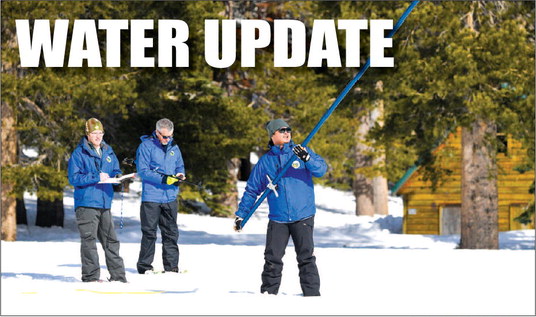
WATER UPDATE
State records heavy rain, but is drought over?
Editor’s Note: The following information was provided at the Presidents’ Council meeting Feb. 2. It is reprinted here for the edification of all LW residents.
by Karl W. Seckel, P.E.
director, Municipal Water District of Orange County
You might think that the recent parade of storms hitting California (now called atmospheric rivers) would have resulted in the end of the drought.
But when did the drought begin, how is a drought defined and how do we know when we are “out of a drought?”
My 45 years in the water industry in Orange County and Southern California has led me to the following conclusions:
• Since the year 2000, we’ve endured 17 years of below-average water runoff in the two watersheds—the Northern Sierras and the Colorado River Water Basin—that provide valuable imported water into Southern California.
• We had a record-dry four-year period from 2012 -2016 that was eclipsed by another record-dry three-year period from 2019-2022.
• Mother Nature has substantially changed how she delivers water to us. Each year is a mystery. Typically we don’t know how much supply we will have to manage until the end of April for the year ahead. Stay tuned for the results in 2023.
• Substantial investments to the tune of $5 billion since 1990 in storage in Southern California and in Central Valley groundwater basins and in Lake Mead, investments in water use efficiency and investments in local projects, including recycling, have helped us survive these low supply periods without major mandatory water use restrictions. Per capita water use has dropped by over 40% since 1990 in Southern California. Simply put, we’re using less water, even with many more people living here.
• Unfortunately, dealing with the Colorado River’s over-allocation and California’s shrinking snowpack will necessitate additional significant investments in the future. We must be more adept at capturing water in wet
years (we will still have them) and storing it away for dry years.
Some would say there has been an epic failure by our state to get critical infrastructure built to deal with climate adaptation.
Others blame the myriad of regulations. There is nearly unanimous agreement that warming trends will reduce the opportunity to store water in the mountains in the form of snow. California’s biggest reservoir has always been the Sierra snowpack, which is projected to reduce by 10-20 million acrefeet of equivalent storage. That’s more than Shasta, Oroville and San Luis reservoirs combined. All were built in the 1960s or before to provide carry-over supplies for farmers and urban customers.
It seems irrational to run a state with fifth largest economy in the world using such an outdated water system.
Dealing with this future requires an “all of the above approach” to use water wisely. Additionally, we must utilize opportunitiestoturnwastewater into potable drinking water. We need further collaboration with farmers. Most importantly, we need to invest in infrastructure that will allow us to capture precipitation during wet years and deliver it to where it can be stored, primarily in groundwater basins, for future use.
Gov. Gavin Newsom’s administration seems to be heading in the right direction, but the speed and participation bythestateneedstobeamplified. The issues facing us are beyond the ability of the water agencies to fix without the help from Sacramento.
Investments are needed for both water supply and flood control, and partnerships and collaboration should help spread the costs and make reliability more affordable throughout California.
California doesn’t have a supply problem. We have a storage and delivery problem. If Sites Reservoir or the Delta Conveyance Project were in place this year, we would have considerably more water in storage at this time.
And no, the drought is not over. It will be over when our levels of storage increase to allow us to deal with the extreme swings in supply.
Recovery from multiple years of drought will not occur in a single year. Several wet years are needed.
There is good news, though. Storage reservoirs have begun to recover in early 2023. But we’ve seen this before. In fact, last year at about this time, after a very promising start to the winter, Mother Nature’s spigot turned off entirely for three months and put us back in a hole.
Maybe Mark Arax, a columnist for the New York Times, whose most recent book is “The Dreamt Land: Chasing Water and Dust Across California,” captures the vagaries of water in California best: “A flood year always breaks the drought years, or so my grandfather, the raisin farmer, told it. Drought is California. Flood is California. In the wettest years, rain and snowmelt coming down the rivers produce some 200 million acre-feet of water.
“In the driest years, they produce 30 million. Between the extremes lies an average year, which happens so infrequently that it is a myth we tell ourselves. As long as we keep faith in the average, it is us and not nature in command.
“When we’re in the midst of drought, we have no memory of flood. When we’re in the midst of flood, we have no memory of drought. Amnesia is how we built agriculture across marsh and desert and houses in floodplains and canyons of fire.”
In California, we need to plan and build infrastructure for both extremes. In the meantime, let’s keep our fingers crossed for more rain and snow in February and March.