Bus ridership up 40% under on-call system
TRANSPORTATION
by Emma DiMaggio
Communications Manager
Thirteen months after the Golden Rain Foundation did away with its fixed-route bus system and transitioned to an on-call, point-to-point system, the results are exceeding expectations. Ridership has increased 40% in the first year. On average, LW’s buses gave 998 more rides per month in 2025 compared to 2024, and that growth shows no sign of slowing.
“It’s been incredibly successful, so much more so than we ever imagined. It’s absolutely amazing,” said Chris Altenes, a Mutual 4 resident and longtime GRF bus driver of 12 years.
On a recent Thursday morning, Altenes manned the driver’s seat of an eight-seat Minibus equipped with a remote-activated wheelchair lift—one of Leisure World’s two Access buses. Accompanied by the idle roar of the AC and intermittent chatter from her handheld radio, the shift would be a mix of pre-scheduled pick-ups and on-call support for the regular buses.
“Everybody needs to get out and about—to the grocery store, Ralphs, the medical center, outside hospitals, Sprouts, Target, any place,” Altenes said. “We have ways of getting them where they need to go.”
Seven days a week, residents request rides through the Transportation Department’s dedicated phone line: 562-472-1367.
Buses zip from carport to clubhouse, to medical appointments, grocery runs, social events, religious services and more.
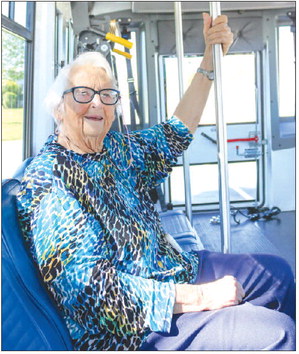
Penny Squibb of Mutual 5 lives near the Amphitheater and takes regular rides to Primrose Restaurant in the Seal Beach Shopping Center. She’s familiar with the bus and its drivers, who she refers to as “my girls.”
“They’ve been good to me,” Squibb said. “Sometimes I just get up and go for a ride.”
In addition to destinations within the wall and nearby Seal Beach Village Shopping Center, the GRF Minibuses connect residents to local transit hubs at the Main Gate and Amphitheater bus hub, linking them to broader transit networks.
“People ask me, ‘Where do you go?,’” bus driver Altenes said. “My comeback is, ‘Where would you like to go?’” Riders can use these networks to travel to faraway locations throughout Los Angeles and Orange counties— though residents’ favored destinations are Target and Ralphs, located in the Old Ranch Town Center north of Leisure World.
“I think [the bus] is more valuable than any amenity that’s entertaining, because it’s how these people get to the grocery store, to the doctor’s office, to the dentist, to the hearing aid center,” said longtime bus driver Peggy Walter. “People rely on it, and you could be there one day too, you know?”
Charting the popularity of LW’s buses
In 2025, drivers provided more than double the number of non-access rides per month than the previous year—up from 265 to 587.
For some riders, like Mutual 2 resident Inge Lizarraga, the buses are indispensable. She hasn’t driven a car in four years. She rides the bus to the Aquatic Center every morning.
When she’s ready to come home, she calls the dedicated Minibus phone number and waits for a bus to arrive. The average wait time is 5-10 minutes, according to GRF Transportation Manager Grant Winford, and up to 12 minutes during peak hours.
Helen Mercatoris of Mutual 9 uses the assistance of a rollator to keep her balance when she’s out—and just a cane at home. She’s always used the appointment- based Access Bus to get to her doctor’s appointments at the Optum Health Care Center. Despite no substantive change to the Access Bus service model, appointments have increased 37% in the past year.
The shift to on-call service marks a dramatic turnaround from years of declining ridership under the fixed-route model.
After a peak in 1985, bus ridership in Leisure World evened off in the late ‘90s and then began to drop in the 2000s, according to Winford, who has worked for GRF for 45 years. By 2010, ridership had leveled off at a far lower number than the peak in 1985.
People once relied on the buses to get around. New residents moving in were healthier than previous generations, and more likely to walk to their destinations. “Eighty is the new 55,” Winford said. Vehicle ownership also increased steadily since Leisure World’s founding in the 1960s, according to Census data, and people today are more likely to drive than take the bus.
‘The breaking point’
By the early 2020s, residents regularly criticized the underutilization of the buses, pointing out their frequent sightings of empty buses.
Prior to 2025, the GRF Minibuses operated on four fixed routes: the A, B, C and D routes. The system had its flaws. People had to time their departures to make sure they caught the bus at the right interval, and a full loop on the bus took 40 minutes.
The Great LW Discovery Tour, a community-wide amenity showcase held in April 2024, showed the community what was possible. Buses gave over one thousand rides in a single day, whisking residents from clubhouse to clubhouse to explore clubs, live music, vendors and more.
“It became obvious that, wow, we’ve got bus service that can do this,” Winford said. “That was the breaking point. We could see what we could do, what we were doing, and what might be possible.”
The Discovery Tour had planted a seed. In 2024, the community was hit with a blow: a $1.1 million increase to Leisure World’s insurance premium led to an increase in assessments. Board members searched for ways to cut costs.
“That’s when we began to have board members seriously look at alternatives,” Winford said. The underutilized bus system came under review.
The GRF Board considered alternatives: bringing in an outside contractor with its own buses, or outside drivers to operate GRF’s buses. One company offered small, electric vehicles that could be summoned via app. Committee meetings, town halls and public comment periods followed.
Ultimately, the Transportation Department came forward with its own proposal: a pointto- point bus system that would reduce the operational hours of the bus, shorten wait times, and decrease total driver hours.
GRF would own its buses, which would continue to offer transportation during highvolume special events like the Fourth of July Car Show and summerlong Amphitheater Season. GRF would also retain its seasoned drivers, many of whom are intimately familiar with the features and quirks of Leisure World.
The proposal was approved by the GRF Board of Directors on Sept. 24, 2024. It came into effect on Jan. 1, 2025, with immediate success. Ridership steadily grew throughout the year.
“I’ve gotten 95% positive feedback from the riders about this new system,” Walter said. “They absolutely love it.”
Winford attributes that success to his drivers.
“The current success, and what I believe will be the continued success, is specifically due to those who are operating the buses,” Winford said. “I tell all my drivers, ‘We are not care givers, but we do care about every single person who boards our buses.’” Learn more about local transportation options The GRF Transportation Department offers bus orientation meetings on the first Thursday of every month in Clubhouse 3, Room 3 at 10 a.m. to help residents understand local transportation options. The meetings cover the GRF Minibuses as well as the Seal Beach Senior Shuttle, local hospital shuttles and more. The next meeting is April 2. No reservation is required.
—GRF Transportation Manager Grant Winford

Longtime bus driver Chris Altenes (l) drops off Mutual 9 resident Helen Mercatoris at the Optum Health Care Center using the Access Bus wheelchair lift. The purchase of GRF Access buses was made possible thanks to a $124K donation from the Golden Age Foundation.Emma DiMaggio