Police educate residents on California golf cart laws
FORUM WITH SEAL BEACH POLICE
by Ruth Osborn
Communications Director
Scores of residents spent a couple hours Feb. 11 at a town hall in Clubhouse 4—the second since October—to learn more about a recently launched golf cart initiative by the Seal Beach Police Department. Specifically, SBPD seeks to ensure that all drivers of low-speed vehicles, commonly mistaken for golf carts, are licensed and registered by the California DMV.
Capt. Mike Ezroj and Detective Kendra Owen, along with GRF Security Director Victor Rocha, emphasized that the main goal is to educate people on the difference to bring everyone in compliance with the law.
“We’re not going to come in here and write 1,000 tickets,” said Capt. Ezroj. “The issue we see in here are people... causing collisions because they lack the skills and abilities to operate vehicles. This continues to be our biggest problem.”
The Difference between Golf Carts and LSVs The first step for residents is to discern whether they own golf carts or low-speed vehicles.
Golf cart drivers do not need to have a California driver’s license, registration or insurance. The carts do require GRF decals. According to California Vehicle Code Section 345, a golf cart must:
• have seating for no more than two people, including the driver.
• have at least three wheels on the ground.
• weigh no more than 1,300 pounds.
• have a maximum speed of 15 miles per hour.
If these criteria are not met, then residents are driving low-speed vehicles (LSVs). LSVs are four-wheeled, streetlegal electric vehicles with top speeds of 20-25 mph and a gross vehicle weight rating under 3,000 pounds. They are designed for roads with 35 mph or less speed limits. LSVs require registration, insurance and safety features like seat belts, headlights and turn signals. LSVs without VIN numbers will require a VIN verification in order to register with the DMV.
That means drivers must be licensed— even when carts are operated on Leisure World’s private, Mutual- and trust-owned streets.
According to Rocha, most residents own golf carts, which only require GRF decals—not a driver’s license—and can be driven in Leisure World but not on public streets outside of the community.
But a significant number of people may have LSVs without knowing it, he added. Often, they are sold as golf carts, but legally, they are considered motor vehicles, and driving them without license, registration and insurance is a violation subject to citation, and possibly vehicle impoundment.
Why the Renewed Cart Focus—Poor Drivers in LW Seal Beach police got serious about bringing carts into compliance in the
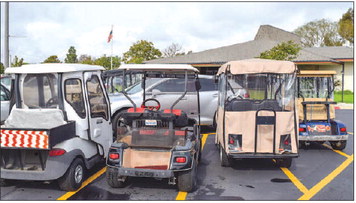
Golf carts filled a designated cart parking area in front of Clubhouse 4 dur -
ing the Feb. 11 town hall.
Ruth Osborn wake of increasing reports of unlicensed drivers involved in accidents causing injury and property damage. The situation culminated May 14 when an unlicensed resident driving a LSV hit a parked car and later died of his injuries.
“The fact of the matter is: there are people here who no longer have the ability to drive, whether it’s a car, motorcycle or golf cart,” said Rocha.
“We want to make the roads safer,” said Capt. Ezroj. “Our whole point is to get people into compliance with the law. Education first, then enforcement.”
Seal Beach Police Capt. Mike Ezroj,Detective Kendra Owen and GRF Security Director Victor Rocha at the town hall.