Board receives traffic signal update
GRF BOARD RECAP
by Ruth Osborn
Communications Director
The GRF Board of Directors met Sept. 22 to handle a wide range of issues, including community garden leasing fees, an upgrade at Veterans Plaza, and updates on the Stock Transfer remodel and the traffic light safety project at St. Andrews Drive and Golden Rain Road.
Comments from 15 residents covered everything from the budget, GRF management and the search for an executive director, plus how to handle potential ICE intrusions into the community, which the board sent to the Operations Committee for further consideration.
GRF President Linda Herman announced that the remodel of the Stock Transfer Office is nearly complete. She noted that the work was done in-house by Service Maintenance with an eye to maximizing a “congenial customer service experience.” The office is set to open Monday, Oct. 6.
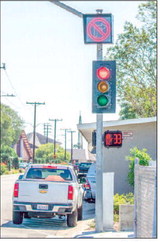
Senior Facilities Director Mark Weaver told the board that the traffic light safety upgrade is now working as designed. (See page 4 for updated information.) Located at Golden Rain Road and St. Andrews Drive, the signal operates on a cycle that includes a 46-second pedestrian-protected
Lighted "No Right Turn" signals are now working.
Paul Kryczko phase. This phase halts all traffic, including vehicles making right turns, when pedestrians push the cross button. Pedestrians should only enter the intersection when the lighted signal shows the “Walk” sign. The pedestrian cycle will now only be triggered if someone is crossing the intersection.
The failed controller, which operated the light sequencing phases, has now been replaced with loaner pending the purchase of one by GRF. Initially, the repair was estimated to cost about $60,000, but GRF management worked closely with the contractor and manufacturer of the system to find a less expensive way. The new equipment will cost about $5,300, which is covered by the board-approved project contingency fund.
“I consider this good news for the community,” said Herman, adding that diagonal crossing is not permitted. Pedestrians should stay in crosswalks for safest passage.
More good news came from Optum representatives who reported that improvements are being made to a new phone system that was implemented in July, triggering excessive wait times for patients, sometimes as much as 30 minutes.
Susan Graham, Optum vice president, Patient Support and Contact Center, told the board that the installation of the new system and a health records management system did not go smoothly. “We are behind,” she said. “We acknowledge the issues and take ownership of them.”
Daisy Salvador, Optum director, Patient Support Center Operations, said Optum has added 13 staff members, reducing wait times to two minutes, with a goal of 30 seconds by the end of the year.
In other business, the board considered the following.
Community Garden Policy
Upon the recommendation of the Member Services Committee, the board voted to lower the lease fee of gardens to $75 per plot and credit first-year gardeners (who paid $150 per plot per year) for future garden leases.
TPUF Reallocation
Upon the recommendation of the Administration Committee, the board voted 8-6, with one abstention, to reallocate the 2026 GRF Trust Property Use Fee (TPUF). Formerly called the amenities fee, new residents and some transfers pay $7,000 per household when moving into to Leisure World. In 2026, the TPUF is projected to bring about $3.6 million into GRF coffers.
The TPUF traditionally allocates 40% to the capital fund and 60% to reserves; in 2024, nothing was allocated to the capital fund, as the money
A plot at the Community Gardens will now cost $75 annually, down from $150. Exist - ing gardeners will receive credits toward another year of plot fees or an additional lot.
Paul Kryczko was channeled to operating funds to cover an unexpected and hefty increase in the GRF insurance premium.
For the 2026 budget, GRF is projecting sales of 400 units, and TPUF-related transfers of 120 units, amounting to about $3.6 million.
The reallocation of 2026 TPUF revenues approved Sept. 22 will channel $210,950 per month to the reserve fund for an annual total of about $2.5 million; and $5,000 per month to the operating contingency fund, not to exceed $60,000 annually, with the balance to the capital fund until it adds $1 million to that fund.
In a separate vote, the board agreed to only use unallocated TPUF funds, estimated at about $48,000, to augment the operating contingency fund.
GRF Treasurer Sandy Geffner, who proposed the reallocation strategy, urged the board to pass the plan, saying that GRF needs to feed its capital fund so it can be used as it was intended, which is to add new amenities. He noted that the new reallocation could also lessen the amount of assessment increases because TPUF revenue comes from new move-ins and not existing residents.
Director Nick Massetti thought the move would “put a tremendous handicap on our cash flow because funds borrowed from one fund to pay another have to be repaid in four months.”
President Herman also didn’t like the idea of borrowing between funds, saying staff has established a two-year recovery plan that is working and needs one more year focused on monitoring spending from and minimizing contributions to the capital fund.
GRF Interim Executive Director Dave Potter recommended leaving the funding model as it is because the reallocation strategy “presumes that the GRF won’t have an unanticipated financial event between now and the end of 2026. GRF has been treating the capital fund as an extension of the operating fund. I want to see a healthy capital fund that truly is only used for capital projects that we don’t have to rely on for unplanned business expenditures.”
Veterans Plaza Concrete
Upon the recommendation of the Facilities Committee, the board unanimously voted to spend $14,527 to resurface the concrete at Veterans Memorial Plaza, plus a 10% contingency for a total cost not to exceed $15,980, reserve funding.
Veterans Memorial Plaza, located between Clubhouse 3 and 4, needs a resurfacing of the concrete to repair cracking. GRF President Herman thanked GRF Director Namil Shin from Mutual 14, who was instrumental in finding a vendor who could resurface the plaza for less money than several vendors that were considered at last month’s board meeting. Pedestrian Gate System and ID Card Replacement The board voted to have the Operations Committee review a project to replace Leisure World’s six failing pedestrian gates.
The committee will discuss cost adjustments and how to present the project scope to the community.
The current pedestrian gate access system is outdated, relying on mechanical card readers that are no longer manufactured or supported ( for full story, see page 1).
Service Maintenance staff are currently performing daily repairs with makeshift solutions to keep the gates operational.