They needed a bigger room. ….
They needed a bigger room. The group found a permanent practice space near Veterans Plaza, the club’s practice venue for the past 20 years. In the early days, dancers practiced long hours to master their craft.
Reflecting on the past two decades, Weingart gave special credit to her late husband, Joe, who assisted the club with technical work such as music and dance charts, taking photos and transporting dancers: “He was wonderful, not a word or complaint about the time I spent on hula. And believe me, that’s a lot of time and energy.”
“We used to stay here until 7 o’clock,” Cucci recalled. “I’d call my husband and say, ‘I’m not coming home for another hour.’” Weingart was persistent. Her catchphrase became, “One more time.” Those who have been in the club since the beginning have learned hundreds of unique hula dances, each with different songs and long, complicated strings of movements. Dancers know the movement that represents the swaying of a palm tree, a wave in the ocean or a feeling of yearning.
“In the beginning, it took me six months to teach one hula,” she said. “After that, it was easy. Now I can teach a hula in a week, in three hours. The dancers just know. But at the beginning, it was really tough.”
Before long, Hui O Hula was soliciting shows inside Leisure World—Mutual activities, clubs, birthdays—and outside the walls at senior centers, senior clubs and tourist areas.
“Jojo had a van and seven of us would excitedly give her conflicting directions,” said longtime dancer Kaye Huff, the club’s event coordinator. “She didn’t know the area at the time since she had just come from Hawaii, and there was no GPS then. We said that Jojo traveled with the angels.”
By the mid-2000s, Hui O Hula was performing at over 100 shows a year, sometimes dancing at multiple venues a day.
“We wore that van out,” said Huff, who performed at many of the club’s early events.
The club’s performances became a favorite among residents, and they earned a reputation for bringing joy and Hawaiian culture to senior facilities. Dancers new and old agree that performing at convalescent homes, assisted living facilities and memory care facilities has been the most rewarding part of joining Hui O Hula.
In addition to its performances outside Leisure World, the club hosted Hawaiian events inside the community, with live music and raffles. With the money it made from paid gigs and club-organized events, Hui O Hula purchased mirrors for its upstairs practice room in Clubhouse 6, now known as the Mirror Room.
After immersing themselves in hula, club members decided to organize their own island adventure. In 2008 and 2010, Hui O Hula members traveled to Hawaii together.
Weingart’s friends from the island acted as the club’s guides: her hula teacher, Kumu Valerie Lui Kwan, gave Hui O Hula members the grand tour, explaining the island’s diverse history. Another friend, “Ukulele Ernie,” serenaded them with songs on his ukulele.
Members synced up their trips with the island’s main attraction: Merrie Monarch, a week-long cultural festival and hula competition in Hilo, Hawaii, that attracts hula dancers from across the globe.
“When you walk in the room, you get this huge whiff of flow-
“In the beginning, it took me six months to teach one hula. After that, it was easy. Now I can teach a hula in a week, in three hours. The dancers just know.”
— Jojo Weingart, Hui O Hula president and dance teacher ers,” said Mutual 15 resident Susan Saraf, who owns a sailboat and is known by fellow members as SeaSickSue. “It’s the event of the year.”
Members filmed the dances and, upon their return to Leisure World, hosted a dual video screening and pajama party for those who weren’t able to attend. Leisure World’s Hawaiian dancers would flock to Clubhouse 6 in hair rollers, night robes and slippers.
Over the years, the club has remained a space where members form deep connections, share cultural knowledge and support each other. Interest in hula has remained strong, as has Weingart’s sense of Aloha spirit.
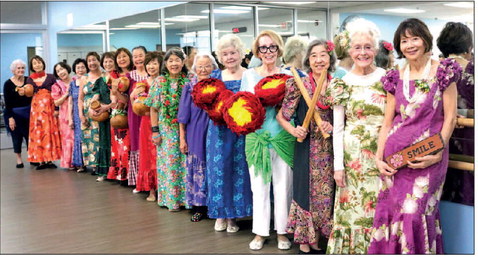
When Mutual 11 resident Shigemi Susie Yokomi decided to join the club in 2021, she was concerned about attire. She didn’t own a floral muumuu, which most dancers wear to class.
Weingart had just the solution. She told Yokomi to come over to her house and pick out a muumuu for herself. She had plenty, and called another member to bring over some extras to widen the selection.
“I ended up taking home two and I still wear them to this date,” Yokomi said. “I found out later that everyone in the class was the same way. It is that Aloha spirit—everyone loves others and is willing to help anyone in need.”
In 2020, the COVID-19 pandemic threatened to shutter the club, but Hui O Hula adapted. Dancers organized classes outside and practiced social distancing. Despite the setback, the club grew during the shutdown.
During this time, Mutual 9 resident Mel Blake drove past what she described as “a flurry of costumes and flowers” on a greenbelt.
“It really perked my interest,” said Blake, who joined the classes shortly after. “It gave me a chance to make new friends and reconnect with old ones.”
When Mutual 6 resident Helen Wu first noticed the dancers practicing near Veterans Plaza, she thought it was a luau.
“I thought, ‘Oh, they’re having a party over there.’ I went over to check it out, and they invited me to dance,” Wu said. “I had tried Zumba, but it was too fast. I have knee pain. When I dance hula, it’s so comfortable. It’s all slow movement.”
New dancers, like Wu and Nora Fredlund, who returned to dance after a health setback, find comfort in the dance lessons. The combination of soothing ukulele music, tranquil movements and the supportive, positive Aloha spirit of fellow dancers creates a sort of salve.
“This is like therapy to me,” said Fredlund, who returned to class as soon as she could. “They’ve been so supportive. It’s an amazing group.”
Hui O Hula continues to hold dance classes twice a week at 1 p.m.—on Tuesdays in the Mirror Room at Clubhouse 6 and on Thursdays at Veterans Plaza, or inside Clubhouse 3 during inclement weather. Dancers of all skill levels are welcome, and many simply come to observe.
Those who want to learn to hula are encouraged to wear something comfortable, like a long flowy dress or a sarong tied around the waist. Footwear is not required.
Those who do not want to dance barefoot should bring socks or soft booties.
“Hui O Hula is much more than a Leisure World dance club,” said Mutual 10 resident Lori Chamberlin, who attends classes twice weekly. “It’s a family, uniting many different cultures under the umbrella of Hawaiian culture.”
For more information about the club, call 562-431-2242 or email jojo@huiohula.com.

Hui O Hula dancers pose with a red convertible in November 2011.Ruth Osborn

In 2010, hula dancers traveled to Hawaii together to soak in theisland's historyand culture.Jojo Weingart