Brain Boot Camp: memory training techniques to improve the brain health in older adults
by Katya Lukina
LW staff writer katyal@lwsb.com
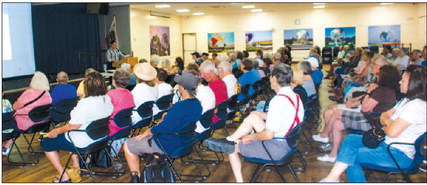
On July 24, over 90 residents gathered in Clubhouse 4 for the second class of a two-week Brain Boot Camp series presented by the Memory Support Team and Alzheimer’s OC.
Social worker Traci Bell discussed strategies for improving the memory by paying attention, practicing active observation, and using categorization.
Bell performed a brain exercise by describing a picture with different objects and then followed up with the questions to jog people’s memory.
She advised using a categorization and organization technique to recall information. For example, the objects shown were categorized into office supplies, animals, and items to take to the beach, which made it easier for people to remember. Bell also went over the techniques to memorize faces and names by forming an association with the person’s name or appearance.
For example, identifying facial features (hair, teeth, eyes, nose, freckles, scars), prominent features (size and attractiveness), and visualizing images associated with those observations can help people remember names.
To recall the name, people can work backward by looking closely at a person’s face, and recalling the facial feature, which is associated with the name.
Other tips to remember new names can include people’s occupations, objects, places or slogans with a similar name (black or Smith—Blacksmith; Bookheimer: books); thinking of a familiar person with the same name (Julia—Julia Roberts or Julia Child), or a word that sounds similar to the name (Traci Bell: Trace the Bell; Linda Ecoli: E. Coli Bacteria).
Bell ended her presentation with key techniques and strategies for improving the memory:
• Doing something new.
• Making information meaningful and relevant.
• Improving encoding (paying attention, using imagery, making associations).
• Gettingcreative(visualizing, creating a story, associating faces and names).
• Makingwrittenremindersin lists, calendars, appointment books, diary, emails (medications, things to do, special events for the month).
• Setting auditory reminders on alarm clocks, kitchen timers, watch alarms (for cooking time or phone calls).
• Leaving a message on their own answering machine.
• Using smart devices (Siri, Alexa or Google).
• Preparinginadvance(names of people attending a function or a party; medical history for an appointment; questions to ask at a Committee meeting).
• Developing memory habits (reviewing information before going to bed, distributing practice, adding meaning, using multiple modalities, and learning in sets).
• Deciding what’s important.
At the end of a presentation, LWers were encouraged to fill out a survey in exchange for cookies. The Memory Support Team will give a presentation called Keeping the Home Safe 101 on Monday, Aug. 14, from 10-11 a.m. in Clubhouse 3, Room 1.
See page 15 for more information on that class.